
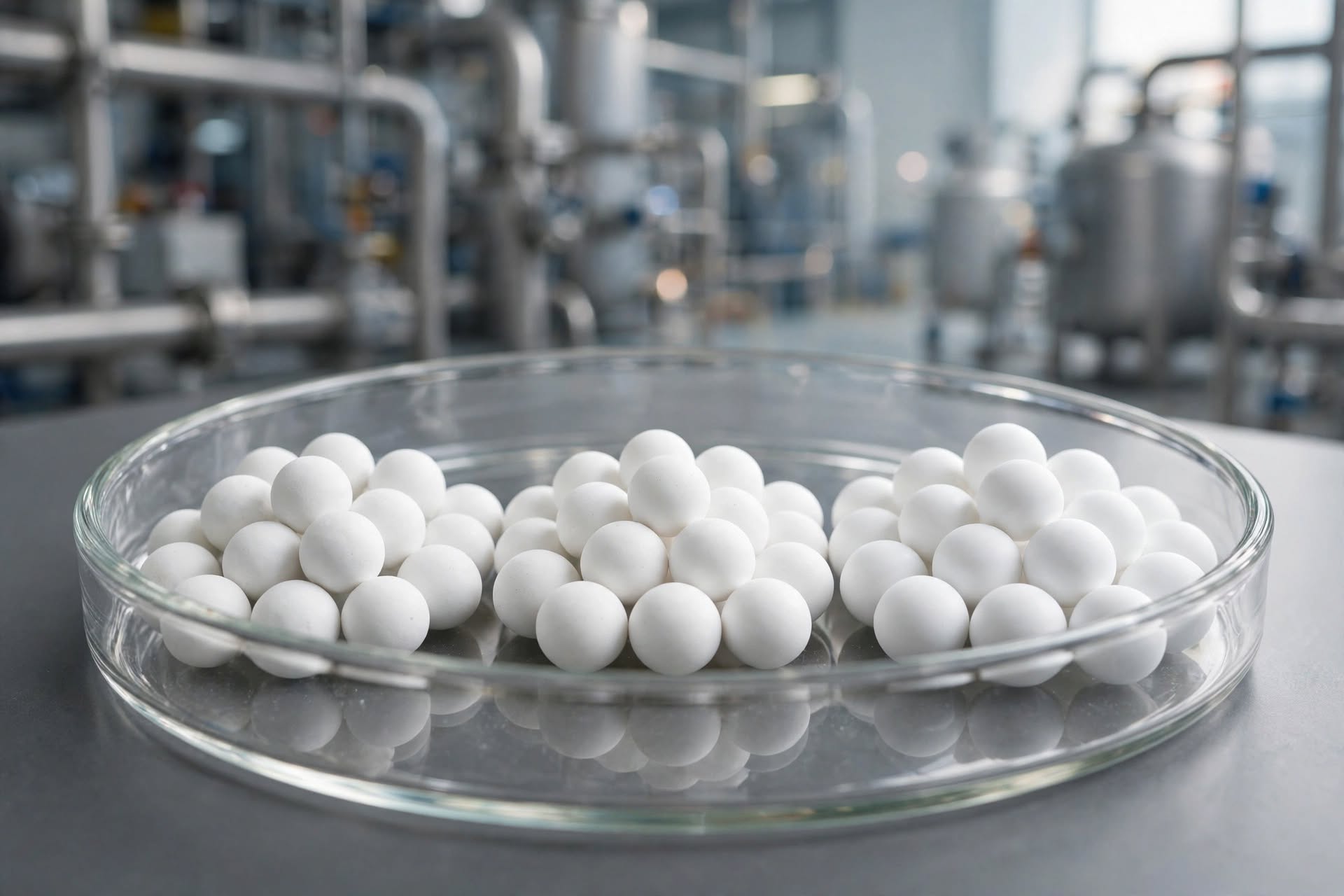
Two balls can look the same and behave very differently
Two alumina balls from different suppliers may look identical — same colour, shape and size. Put them to work, though, and the difference shows up quickly: one set wears evenly and keeps your product clean, the other chips, wears faster, or leaves contamination you did not expect.
That is why choosing alumina balls is about matching the grade, the quality and the job. This guide keeps it simple: what they are, how the 92%, 95% and 99% grades differ, how grinding differs from catalyst support, and what to check before a bulk order.
What an alumina ball actually is
An alumina ball is a dense ceramic sphere made mainly from aluminium oxide, commonly called alumina. It is valued because it is hard, chemically stable, and does not react easily with materials around it — so it can take repeated impact and friction without changing the product it touches.
The shape does two different jobs. In a ball mill, they are grinding media — they tumble and rub against material until it becomes finer. In a reactor, they are support media — they sit by a catalyst bed, spread flow evenly, protect the catalyst from direct impact, and help the bed stay in place. Same shape, different priorities.
92% vs 95% vs 99%: what the number really means
The percentage tells you how much of the ball is alumina. The rest is made up of other ceramic materials used in forming and firing the ball. As purity rises, you generally get a cleaner, more inert ball, but you also pay more. The mistake is to assume the highest number is always the best buy.
A 92% alumina ball is often the sensible, cost-effective balance for general grinding. It offers good hardness and wear behaviour for many paints, ceramics, minerals and similar materials, without paying for purity your process does not need.
A 95% alumina ball is the middle ground. It is a step up where cleanliness and wear matter more — for example, when the colour or purity of the finished product is easier to spoil, or when you want more consistency from batch to batch.
A 99% alumina ball is for high-value or sensitive duty. That includes catalyst support in demanding chemical processes, and grinding or handling where even small contamination is unacceptable. Here, the extra purity is not a luxury. It is protection for an expensive catalyst, a sensitive product, or a process that cannot afford unwanted reactions.
| Grade | Best understood as | Typical reason to choose it |
| 92% alumina | Cost-effective balance | General grinding where good wear is needed without paying for extra purity |
| 95% alumina | Cleaner middle ground | Grinding where cleanliness, colour or consistency matters more |
| 99% alumina | High-purity, very inert | Sensitive catalyst support and high-value, contamination-sensitive duty |
One caution: purity alone does not guarantee performance. Density, structure, firing quality, size accuracy and batch consistency matter too. A well-made lower grade can outperform a poorly made higher grade.
Grinding and catalyst support need different things
If you are buying for a ball mill, wear is your main worry. You want balls that keep their size and shape, do not break up easily, and do not add unwanted material to your product as they wear. Wet and dry grinding behave differently, so tell your supplier how you run the mill and how fine the product needs to be.
If you are buying for catalyst support, the priorities change. Now crush strength matters, because the balls carry the weight of the bed above them. Thermal shock resistance matters, because temperatures can change during start-up, shutdown or process upsets. Low dust matters, because fines can block flow and raise pressure drop. And chemical cleanliness matters, because anything that leaches out of a support ball can reach the catalyst it is meant to protect.
In short, do not use a grinding checklist for a reactor, or a reactor checklist for a mill. Start by naming the job clearly, and the right grade becomes much easier to choose.
How to check quality before you buy in bulk
Before you commit, ask for the datasheet and read it like a buyer, not a brochure. Look for alumina content, density, water absorption, crushing strength for support use, size and tolerance, and — for grinding — the wear test method and result. If a supplier cannot explain how wear was tested, you cannot compare that figure fairly.
Also ask about consistency. Are balls checked for chips, cracks and out-of-round pieces? Will the next consignment match the sample you approved? A serious manufacturer should welcome these questions.
Finally, run a sample trial wherever the line is critical. A trial in your own mill or process, with your own material, tells you more than any catalogue claim. Check wear, breakage, dust and cleanliness after the trial.
A simple pre-order checklist:
- Alumina content and, for high-purity support, silica level
- Density and water absorption
- Crushing strength, if the balls will support a catalyst bed
- Size, size range and tolerance for the size you need
- Wear test method, if the balls will be used for grinding
- Batch consistency and inspection for chips, cracks and dust
Where Refshape fits: high-purity support you can specify clearly
Refractory Shapes Ltd. — Refshape — has been known for quality and reliability in refractories since 1973. That long, practical background matters here, because support media is not a side item in a reactor. It is part of the system that keeps a catalyst bed working as intended.
At the high-purity end, Refshape offers Refrapure, its high-alumina catalyst support described as 99% alumina with very low silica, for catalyst bed supports in secondary reformers, oil refineries and chemical plants, and for the fertiliser, petroleum and petrochemical industries. In sensitive catalyst duty, you want the support to stay inert and not introduce material that could interfere with the process.
A clear boundary is worth stating: do not assume a grinding grade or a size is available just because it is common elsewhere in the market. If you need alumina balls for grinding, confirm the exact grade, size and suitability for your mill directly against the current Refshape datasheet and recommendation. That one check protects both your product and your budget.
Choose the grade that fits the job, not the highest number
If you remember one thing from this guide, make it this: buy for the job, not for the label. Use 92% where it gives you the balance you need, step up to 95% where cleanliness and wear justify it, and choose 99% where contamination, catalyst protection or process sensitivity makes purity worth paying for.
To get a recommendation you can rely on, share these details when you enquire:
- What you are grinding, or which catalyst the balls will support
- Whether the process is wet or dry, where that applies
- Operating temperature and process media
- How much contamination your product or catalyst can tolerate
- Mill size or reactor size, and the ball sizes and quantity you need
With that information, Refshape can advise on the suitable grade and size for your application — and you can confirm the final choice against the current datasheet for your process, media and operating conditions before you order.
Next step: Share your application details with Refshape and ask for the grade and size recommended for your mill or reactor, confirmed against the current datasheet.
Frequently asked questions
1. What is the difference between alumina balls and ceramic balls?
Alumina balls are a type of ceramic ball with a high alumina content. The term ceramic balls is broader and can include lower-alumina inert support balls used in reactors. In practice, always compare the alumina percentage and datasheet properties, not just the name.
2. Is 99% alumina always better than 92% alumina?
No. 99% alumina is cleaner and more inert, which matters for sensitive catalyst duty and high-value products. For many general grinding jobs, 92% or 95% can be the more sensible and cost-effective choice. The best grade is the one that fits your process and contamination limits.
3. Can alumina balls be used for wet grinding?
Alumina balls are commonly considered for both wet and dry grinding, but suitability depends on your material, mill conditions and required finish. Share your wet or dry process, material and target fineness with the supplier and confirm the grade and size before ordering.
4. How do I know if a ball will contaminate my product?
Ask for the alumina content, information on other constituents such as silica, and any leachable or wear information available for that grade. Then run a sample trial with your own material and check the finished product. A datasheet plus a trial is far safer than relying on a grade name alone.
5. What size alumina ball do I need?
It depends on the job. Grinding size is linked to your mill, feed size and target finish. Support size is linked to your reactor, catalyst size and bed design. Give the supplier your equipment and process details rather than choosing a size only because it is commonly stocked.
6. What does crushing strength mean for support balls?
Crushing strength is the load a ball can take before it breaks. For catalyst support, it matters because the balls carry the bed above them. Check the crushing strength for the exact size you need on the datasheet, since it varies with size.
7. Why does very low silica matter in Refrapure?
Refrapure is described by Refshape as 99% alumina with very low silica, for catalyst bed support in demanding industries. In sensitive catalyst duty, a cleaner, more inert support helps reduce the risk of unwanted material reaching the catalyst. Confirm suitability for your specific process before use.
8. Can alumina support balls be reused after a catalyst change?
Sometimes they may be inspected and considered for reuse, but this depends on their condition, contamination, breakage and your plant procedure. Do not assume reuse is safe. Inspect for cracks, chips and dust, and follow your process and safety requirements.
9. What information should I send for a quotation?
Send the application (grinding or catalyst support), material or catalyst details, operating temperature, wet or dry conditions where relevant, acceptable contamination, equipment size, required ball size and quantity. This helps the supplier recommend a grade instead of only quoting a price.
10. Are alumina balls suitable for food or pharmaceutical use?
Suitability depends on the exact grade, your process and the regulatory requirements that apply to your plant and product. Do not assume approval from the material name alone. Ask for the datasheet and compliance information for the specific grade, and confirm it with your quality team before use.