
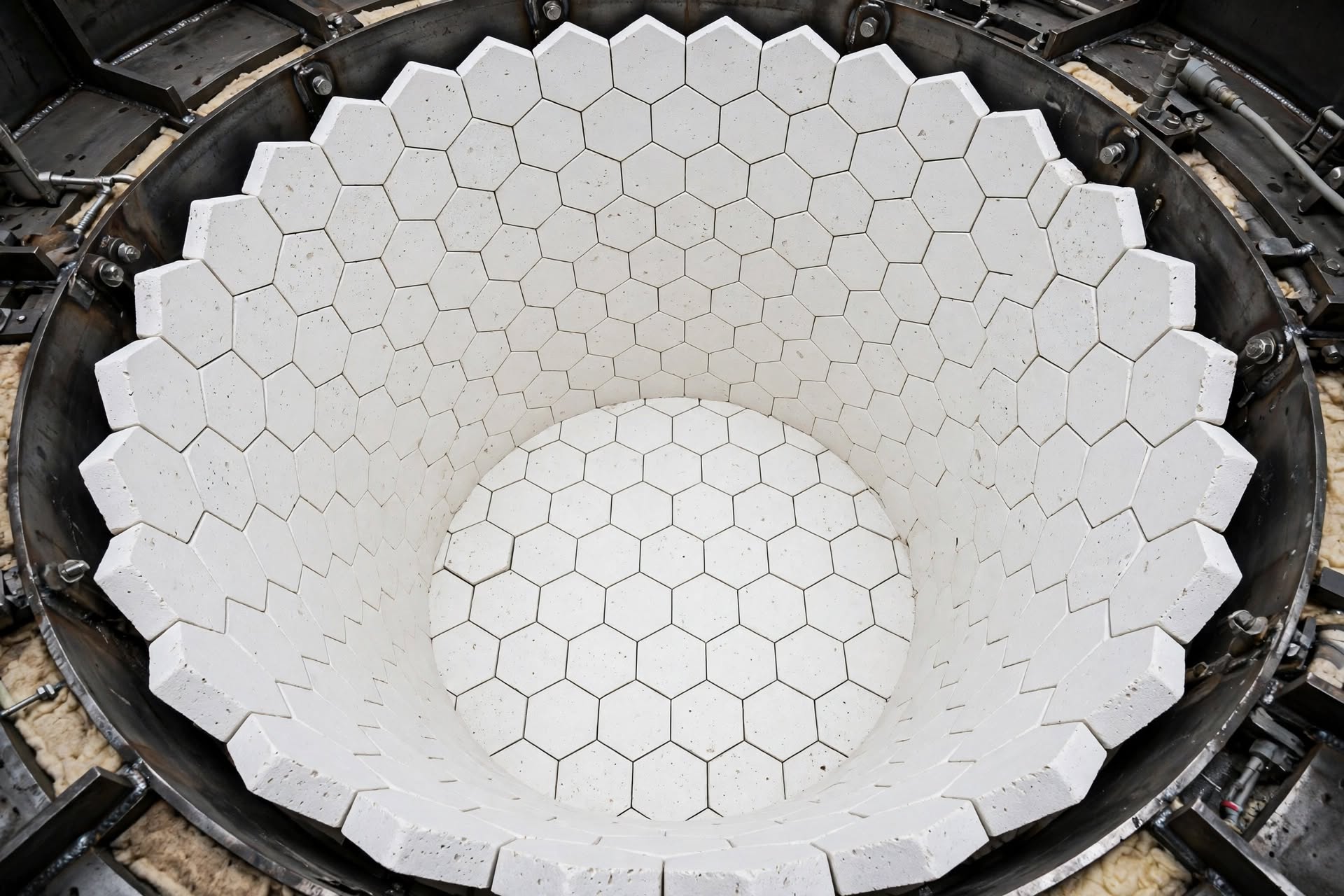
When a refractory lining fails, people usually blame the material first. Was the alumina content too low? Was the brick not strong enough for the temperature? Those are fair questions, but they miss something just as important. In many domes and curved vessels, the lining does not fail brick by brick. It fails at the joints. And the number of joints you have, how long they are, and how they move when the lining gets hot are all decided by one thing: shape.
That is why hexagonal bricks deserve a closer look. A hexagonal brick, often supplied as a hexagonal tile, is not a design choice made to look different. It is a practical answer to a real problem — how to line a curved, hot, loaded surface so the pieces support each other instead of working against each other. If you work on secondary reformers, domes, or other high-temperature linings, understanding shape will help you specify better and avoid rework at shutdown.
Why shape matters, not just material
As a vessel heats up, every brick expands a little, and as it cools, it contracts again. If that movement has nowhere to go, stress builds up. With long, straight joints, that stress can travel in a line, open a joint, or push a section out of place. Repeated heating and cooling, load, and pressure add up over time.
Shape controls three things material alone cannot: the joint pattern, how load is shared from piece to piece, and how well the lining follows a curve. A rectangular brick can be excellent on a straight wall and awkward on a tight dome. A well-made special shape follows that dome closely, with less cutting and less stress in one spot.
A premium material in the wrong shape can still disappoint. If the pieces do not fit, do not interlock, or leave long joints where movement collects, the lining will still crack, spall, or shift. Good refractory work is always material plus geometry.
Hexagonal tiles spread load and break up straight joints
A rectangle tiles a surface in neat rows, simple and effective on flat walls. The trade-off is long, continuous straight joints in two directions — a clear path for a crack or an open joint to follow.
A hexagonal tile works differently. Its six sides meet neighbours at angles, so you do not get long, uninterrupted joint lines. The pattern breaks up those paths, spreads load more evenly, and holds each tile on several sides. On a curved surface that is a real advantage, because the lining needs to behave as one structure, not as separate rows.
That does not make hexagonal bricks stronger in every situation. For straight walls, flat floors, and simple arches, standard shapes are often the sensible choice — easier to lay, easier to replace, and well understood by installation teams.
Dome bricks are shaped for arched and domed roofs, where the radius changes the fit from course to course. Circle bricks are made for round vessels and openings, where a standard brick would need heavy cutting and still leave uneven joints. The right question is never “Which shape is best?” It is “Which shape follows this vessel and keeps joints under control at temperature?”
Where hexagonal bricks are actually used
The clearest use case is the secondary reformer in a fertiliser plant — demanding, high-temperature equipment where the lining must be dependable over a long campaign. A shutdown for repair is not a small event, so shape, grade, and fit matter a great deal.
Refractory Shapes Ltd. — known as Refshape, and supplying refractories since 1973 — lists its Kyanex Super material for dome bricks, hexagonal tiles, circle bricks, and high alumina lumps for secondary reformers in fertiliser industries. That grouping is useful: these are a family of special shapes for the same difficult, curved, high-temperature duty, where standard bricks alone do not give the fit needed.
Hexagonal tiles are also considered for other domes and curved high-temperature zones where interlock and even load spread are wanted. Start with the vessel drawing, not a catalogue photo. Radius, span, temperature, atmosphere, and support will tell you whether hexagonal, dome, circle, or standard is the better answer for that section.
Think in zones, too. A vessel rarely needs one shape everywhere — the dome, wall, transition, and opening may each need a different shape. Planning zone by zone is usually where the real improvement comes from.
The material behind the shape still has to be right
Shape helps only if the material can handle the service. For reformer and dome duty, that usually means a high-alumina refractory with attention to purity and stability at temperature. Low iron matters, because iron and other impurities can weaken performance in certain atmospheres and, where carbon monoxide attack is a concern, can contribute to breakdown and spalling. Experienced buyers ask about iron content, not only alumina percentage.
Volume stability matters too. A tile that changes size unpredictably will open joints or create pressure points, undoing the benefit of a precise shape. Thermal shock resistance matters for start-ups, shutdowns, and process upsets, when temperature changes faster than in steady operation.
Do not choose a grade from this article alone. Grades within a family can differ, and one grade’s properties cannot be assumed for another. Share your temperature, atmosphere, and duty, ask which specific grade is being offered, and confirm it against the current Refshape datasheet before ordering.
Good installation is what makes a precise shape pay off
Special shapes reward careful installation. Because a hexagonal pattern depends on fit, dimensional tolerance matters more than on a simple wall. A tile slightly out of size affects every tile around it, changes joint thickness, and can create a high spot that takes extra load.
Joint design needs the same care. Mortar choice, joint thickness, and consistency decide whether load is shared evenly. Expansion allowance must be planned, not improvised — the lining will move when hot, and that movement needs a designed place to go. Too little allowance and it pushes against itself; too much or uneven, and joints can open.
Before work starts, check tiles on delivery for chips, cracks, warping, and variation. Where the design allows, set out a section first so a fit problem is found on the ground, not halfway across a dome. Keep a record of which grade and shape went into each zone — it makes the next inspection and repair far easier.
The cost of a poor fit is rarely just a few bricks. It is rework at shutdown, lost time, and a lining that never performs as its material should have allowed.
Tell us the vessel, not just the brick size
If you are planning a dome, reformer, or curved lining, start with the vessel, not a single brick dimension. A useful enquiry includes vessel shape and radius, service temperature, atmosphere, the grade you are considering, a drawing or sample, and quantity. Then shape, grade, and tolerance can be discussed together, as they should be.
Hexagonal bricks are not the answer to every problem. Used in the right place — a curved, high-temperature lining where joint pattern, interlock, and load spread matter — they solve a problem material alone cannot. Get the shape right, confirm the grade on the datasheet, and install with care. Talk to Refshape about your drawing and conditions, and choose the shape your vessel actually needs.
Frequently asked questions
- What is a hexagonal brick used for?
A hexagonal brick, often supplied as a hexagonal tile, is used in curved and domed high-temperature linings where an interlocking joint pattern and even load spread are needed. A common use is in secondary reformers in fertiliser plants, alongside dome bricks and circle bricks.
- Are hexagonal tiles stronger than rectangular bricks?
Not automatically. Strength depends on the material grade, density, and firing, not on shape alone. The advantage of a hexagonal tile is geometric — it breaks up long straight joints and interlocks on several sides — while a rectangular brick may be the better choice for a straight wall.
- Why not use standard bricks for a dome?
Standard bricks can be cut to follow a dome, but cutting can leave uneven joints, wasted material, and stress points. Dome bricks, circle bricks, and hexagonal tiles are made for curved geometry, so they usually fit the radius more closely with more consistent joints.
- Can hexagonal tiles be made to custom sizes?
Custom and special shapes are commonly discussed against a drawing or a sample, because the tile has to match the vessel radius and lining design. Share your drawing, required dimensions, and quantity with Refshape, and confirm what can be supplied before planning installation.
- What alumina grade should I use for a secondary reformer?
There is no single grade for every reformer. The choice depends on service temperature, atmosphere, load, and the zone of the vessel. Refshape lists Kyanex Super for dome bricks, hexagonal tiles, circle bricks, and high alumina lumps for secondary reformers, but you should confirm the specific grade and its properties on the current datasheet for your conditions.
- What does low iron mean in a refractory brick?
It means the material contains only a low level of iron impurities. Iron can affect performance in some high-temperature atmospheres and can contribute to breakdown in conditions where carbon monoxide attack is a concern. Ask for the iron content of the exact grade you are buying, rather than relying on a general description.
- How important is dimensional tolerance for hexagonal tiles?
Very important. A hexagonal pattern depends on each tile fitting its neighbours on several sides, so a small size variation can change joint thickness and create load points. Check pieces on delivery for size consistency, chips, cracks, and warping before installation begins.
- What mortar should be used with hexagonal bricks?
The mortar should match the brick grade, service temperature, and joint design for your lining. Do not choose mortar on price alone. Ask the supplier to recommend a compatible mortar for the specific grade and confirm the recommended joint thickness before work starts.
- Can damaged hexagonal tiles be replaced individually?
In many linings, a local repair is possible, but it depends on the design, access, and the condition of the surrounding tiles and joints. Keep a record of the grade and shape used in each zone and keep suitable spares, so a repair can match the original lining as closely as possible.
- What information should I send for a quotation?
Send the vessel shape and radius, service temperature, internal atmosphere, the zone you are lining, a drawing or sample of the existing shape, the grade you are considering if known, and the quantity required. That allows shape, grade, and tolerance to be quoted together, rather than as a brick size alone.